The “Research Room” section of the UP-ON Archive aims to revitalize archival materials through theoretical research, seminars, self-publishing, and other means, thereby fostering in-depth knowledge production.
On June 17, 2026, the first project of the MAM & UP-ON Live Art Documentation Center, Simple Techniques • Uncovering the Past, was launched in Shanghai. The theme of the first documentation exchange event was drawn from Professor Zhao Chuan’s book A Brief History of Radical Art: Chronicles of 1980s Shanghai. We interviewed Professor Zhao Chuan about the origins and subsequent developments of this book. Due to the length of the interview, we have divided it into three parts—Part 1, Part 2, and Part 3—based on content. The text has been reviewed and approved by the interviewee.
Interviewee: Zhao Chuan
Interviewer: Shao Ye
Date: March 31, 2026
Location: Zhao Chuan Studio, Shanghai
Q: How did the exhibitions you witnessed firsthand or participated in at that time address institutional reviews and public perception?
Zhao Chuan: In the second half of my freshman year at the High School Affiliated with the Academy of Fine Arts, I organized an exhibition with some classmates, which caused a bit of trouble. Over the next four years of my studies, I participated in three exhibitions, and each one basically caused some trouble. But I feel the situation was quite different back then. Everyone—whether teachers or department staff—felt that change was necessary. If you told them we were exploring new ideas or trying something different, they wouldn’t really argue with that.
I think people were more sincere back then, unlike now, when people often use excuses like, “This is just part of the job,” “Just go along with it,” or “Don’t make things difficult for me.” Back then, the consequences of a review could be quite severe. If you insisted on painting abstract art, you might get expelled, lose your job, or even face even bigger trouble. As for our relationship with the public, we were all educated to believe that art should be connected to the public. So even when creating radical art—like our “M Conceptual Art Performance Exhibition” at the Second Workers’ Cultural Palace in Hongkou District—we would have a guestbook where everyone was welcome to leave comments.
We were delighted to have more people come see the work and to engage with a diverse range of people. Back then, we were quite sincere about it—which seems quite different from how “the public” is sometimes invoked in contemporary art today. I think the shift began in the early 1990s. Society as a whole tightened up; many things were no longer permitted, and more radical art seemed to have to be practiced in a semi-underground manner. So, since we couldn’t have the public, we simply stopped seeking them out—it was enough just to have experts, curators, and critics in attendance; the spectacle itself was sufficient, and everything else became less important.
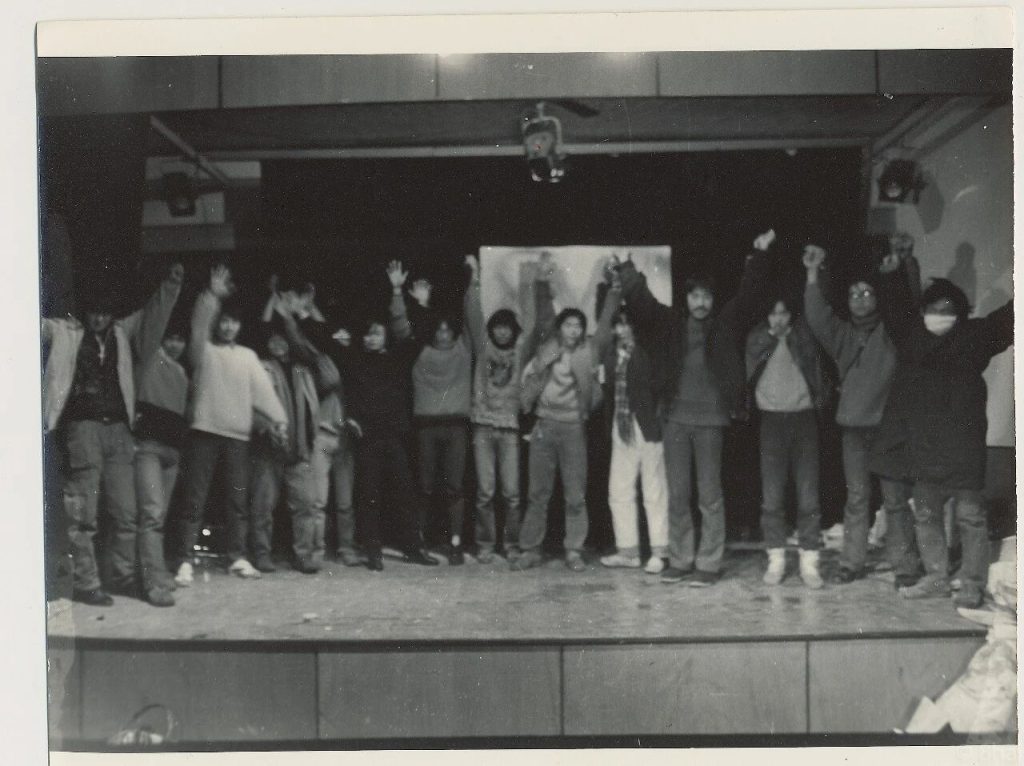
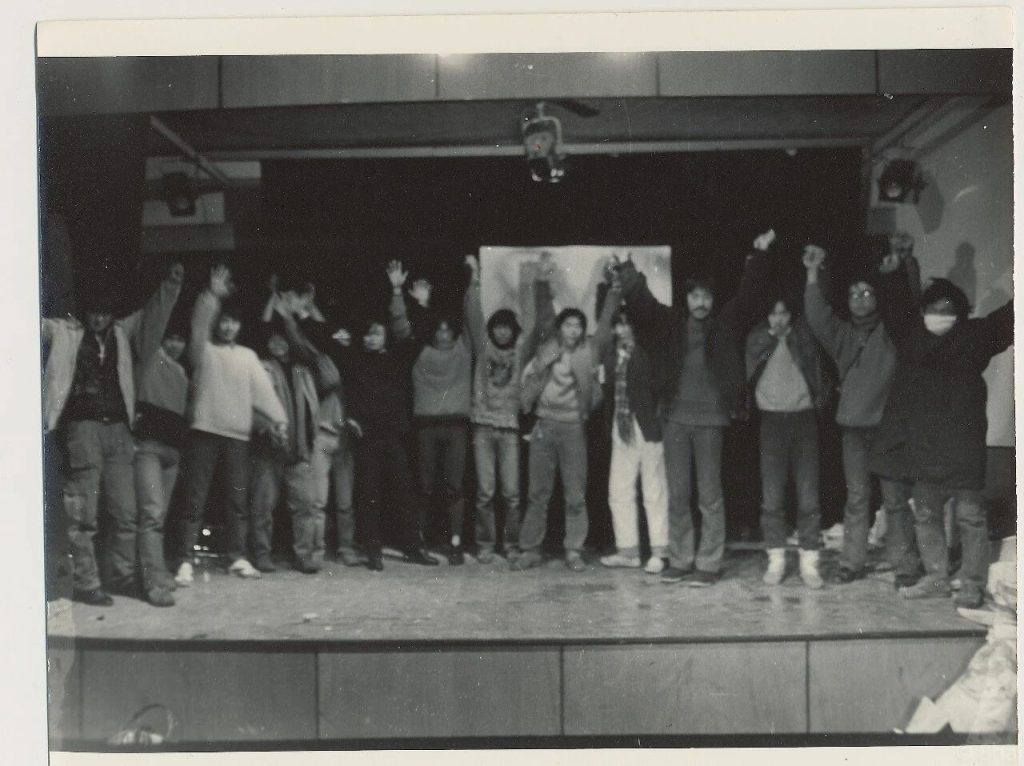
Group photo of the artists taken on-site after the conclusion of the “M Conceptual Art Performance Exhibition”
Q: It’s true, as you just mentioned, that public engagement—or social involvement, if you will—seems a bit forced these days and lacks the sincerity it had back then. What do you think is the main reason for this change?
Zhao Chuan: On the one hand, that educational system has failed; on the other hand, after the crackdown, these art activities became more utilitarian because the art market emerged. The group of artists involved in radical art back then did not accept the dominance of the art establishment—such as the Artists’ Association and art academies. By the early 1990s, a commercial market—including galleries—had gradually taken shape, along with opportunities for international exhibitions. This group of artists outside the establishment formed their own scene and eventually became a new system in their own right.
Q: You mentioned Yang Hui earlier. What were the main activities he was involved in at that time? Could you describe them?
Zhao Chuan: Everyone who knew him back then called him Bahai. He graduated from the Central Academy of Arts and Crafts and later returned to Shanghai, where he taught at the Shanghai College of Light Industry. We met him when he came back for summer break during his college years. He was in his early twenties at the time—a few years older than us—and we hit it off right away. We were all pretty unconventional thinkers back then, so we hung out together.
Before we started the “M” project, he organized a four-person printmaking exhibition at the Xuhui Cultural Center in Shanghai. Many of the works were close to—or already—abstract. He’d grab his engraving knife and, as if bayoneting an enemy, rapidly carve out a batch of prints, then print them all at once for the exhibition.
Originally, after wrapping up the “M Conceptual Art Performance Exhibition,” we had some follow-up plans—including building a house on Chongming Island and other quirky ideas. But after the M exhibition ended, we ran into trouble, so we all had to tone things down, and those plans never came to fruition.
At that time, Yang Hui was probably just keeping his head down and painting; he produced some very large oil paintings. We’d meet up every so often, and before long, I went abroad. He went to France and then came back. In the 1990s, he held quite a few exhibitions in Shanghai—abstract expressionist works with very substantial, thickly applied layers—and later he left. I’ve written about all of this in my book.
Q: Regarding the “M Group” you mentioned, what events or artistic practices took place at that time?
Zhao Chuan: We organized one exhibition; we spent about three months planning it in advance, and then things quieted down. At that time, I was still a student, and everyone was in different situations.
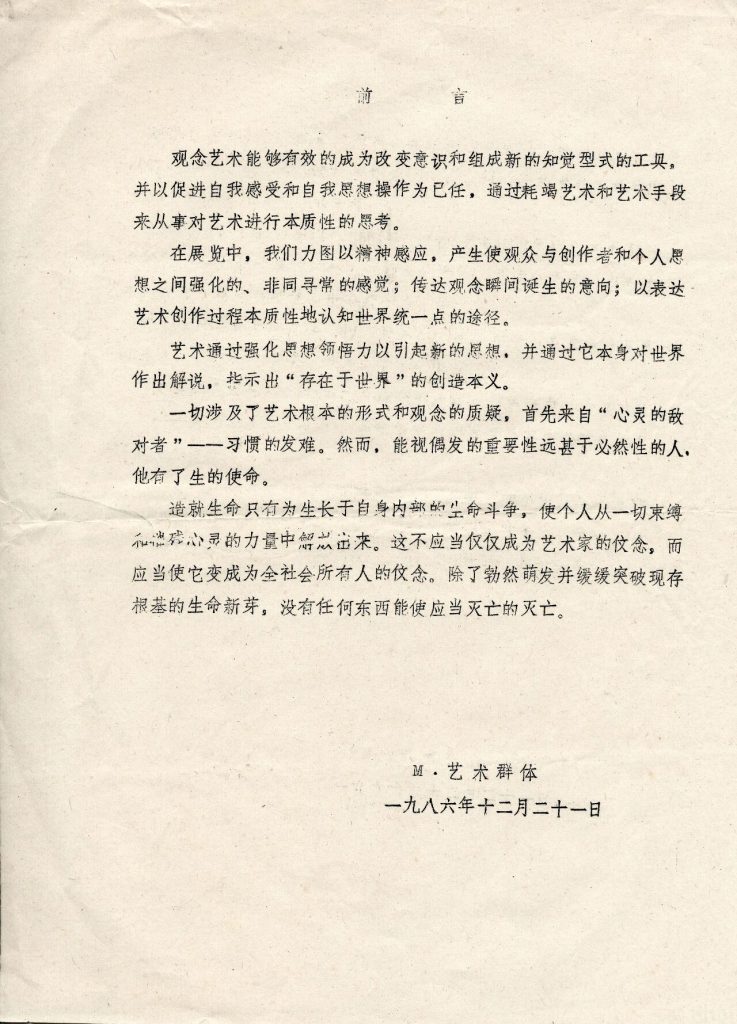
Image from the Foreword to the M Art Collective Exhibition
Q: It seems that, just like today, artists’ approaches remain quite limited, and it’s difficult to deal with the situation.
Zhao Chuan: First of all, people in Shanghai aren’t very fond of working collectively. Back in the ’85 era, China Art News was full of reports about various art collectives, but “M” was the only one in Shanghai that operated under the banner of a collective. This might have had something to do with Yang Hui’s return from Beijing. In reality, each member of this group had their own distinct background—ranging in age from those of us who weren’t even twenty yet to professional art teachers in their forties—and our ideas were quite different as well. We simply reached a temporary consensus on this particular project and worked together to see it through.
Q: While writing this book, were there any valuable people or events that you felt were worth including but ended up omitting?
Zhao Chuan: As I mentioned at the beginning, there was actually an earlier draft. There were some very specific details—especially regarding social events and movements I experienced—that we’ve had to leave out for now. Sometimes, when the outside world delivers a massive emotional shock to an artist, it can bring out something very intense or profound.
Q: So it’s essentially personal feedback from an artist. Do you think the works they’ve created since then would be suitable for inclusion in the folder for this documentary exchange event, as a supplement to your book?
Zhao Chuan: That’s for you to decide. Actually, it’s been a few years since I wrote the book, and I’ve essentially stepped away from that line of work. For several years, I was a writer covering contemporary art for newspapers and magazines, such as Oriental Morning Post (the predecessor of The Paper), Art World, The Bund, Collector·Contemporary Art, and Yishu. Back then, I attended nearly every exhibition in Shanghai and wrote reviews every week.
Several years later, I stopped writing on this topic, and my research came to a halt. I began to focus more on my own creative work. I’ve always felt that my work served as a starting point to inspire others—that more people and more resources, such as academic institutions, could take on this kind of research. Doing it on my own was actually quite arduous: carrying a camera, seeking out people to interview, organizing the material, and covering all the expenses out of my own pocket. Unfortunately, however, I haven’t seen many other publications on this topic since this book came out. That’s why this book still holds a little value today. Looking back now, the writing style feels a bit dated—it’s from over 20 years ago.
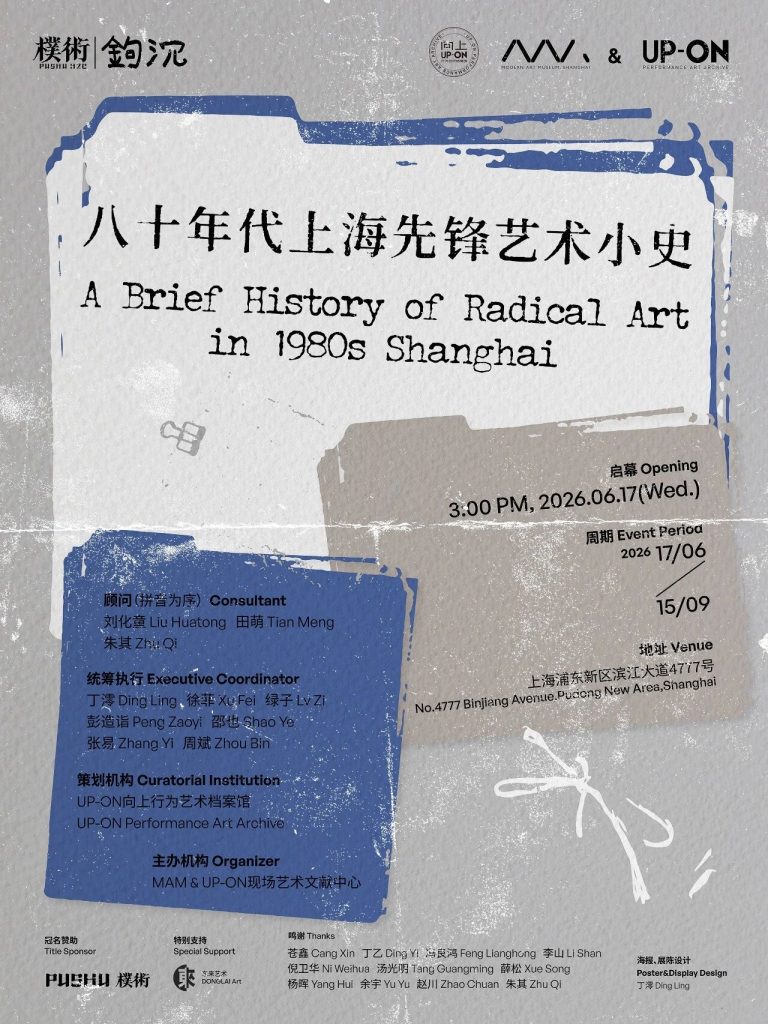
Poster for A Brief History of Avant-Garde Art in 1980s Shanghai
Q: If you were to write this book again, is there anything you’d like to add?
Zhao Chuan: No, I’ve said everything I needed to say, and I’ve fought the battles I needed to fight. The use of the term “radical” was intended to describe the creative work of a small group of people during a specific historical period. I used it as a lens through which to explore certain issues. But today, in an international environment marked by extreme conservatism, how exactly the term “radical” should be used is actually quite perplexing. The situation domestically may be very different—there’s a lack of change. Among the younger generation today, there are more who conservatively believe that society simply follows a cyclical pattern. I, too, sometimes feel powerless—especially after the pandemic, when I’ve experienced even more acutely the sense of helplessness one feels when bowing to the overwhelming pressure of public opinion and capital. Can this so-called “radicalism” help us reflect on certain issues? Can it instill courage and generate more energy for action? If we look to history for inspiration, what might that look like?
Q: Looking at the history of the 1980s—or even the 1990s—what value does it hold for us today, or what lessons can we draw from it?
Zhao Chuan: This is a very old question: Is history useful? Is there any point in studying history? From a utilitarian perspective, what can history offer us today? If it can inspire something or offer some lessons, then it is still useful. But even if it doesn’t inspire anything, does that mean it’s useless? It doesn’t seem to be the case. You surely know this better than I do—otherwise, why would you be organizing these exhibitions? Isn’t the purpose of these exhibitions to breathe new life into history and transform it into a new life experience for future generations?
Q: Regarding that period of history in the 1980s, is there anything beyond what’s in this book that you’d like to present in the exhibition?
Zhao Chuan: To be honest, I’ve already distanced myself from the topics I mentioned earlier. As an art writer, I focused on observing and writing for several years—three or five years—but you don’t see many interesting changes during that time. You start to feel like you’re repeating yourself, merely reiterating things you believe in. I’ve always looked forward to change—I hope to see something young and different. Such things might stimulate me or win me over, opening up new possibilities. But reality hasn’t turned out that way, so I’ve gradually stopped looking at such things as much. Of course, there have been many changes now, though sometimes I can’t quite keep up, and much of it feels familiar. I tend to reflect on these matters more through my own creative work. If you ask what I’m hoping for, I truly just hope that your curation will surprise me.
Q: What we’re doing now might be somewhat similar to what you did back then.
Zhao Chuan: I know saying this might sound a bit like pouring cold water on things.
Q: That’s okay; I think it’s a sincere comment. But even if we stop doing this, there will likely be others who continue it in the future—perhaps this cycle of repetition is part of its significance. People change, circumstances change, but that history will likely remain. Zhao Chuan: Gradually, our circumstances have changed, and life has evolved.
Q: Much of the history of those artistic exchanges from back then likely relies on word-of-mouth accounts from artists or audiences, with no historical records to document them. Regarding this “hidden history,” how do you suggest it should be presented?
Zhao Chuan: There was an incident in the mid-1990s that I didn’t include in my book because it didn’t quite fit into my overall narrative. In Shanghainese, “mi” refers to “money”; saying “mei mi” means “no money.” In the ’90s, when artists held exhibitions, they would treat everyone to a meal after the opening. Over dinner, they’d talk about whether these avant-garde artists and critics were “well-off” or “strapped for cash.” Once, after an opening, an artist gave a bag of rice to each of a dozen or so fellow artists, saying, “You’re all always saying you’re strapped for cash, so here’s some rice for you.” Not even eight or ten years later, when I returned and asked for the specifics of this incident, no one could recall the details clearly. I actually think this is quite good—and quite vivid. At the time, I wondered how to make a judgment. Now I think that if you simply list various things together in a “Rashomon”-like manner, it actually already implies each person’s attitude. When recalling these events—especially those group scenes—the narrator always places themselves at the center of the narrative. Of course, this is understandable, because the perspective is their own. As historical writing, it sometimes relies on time, but time can also wash things away; this is always a paradox.
Q: Based on what you just described, that kind of vague and uncertain history actually stands out even more.
Zhao Chuan: The challenge is that you still have to distill something from it—but what does it mean to “distill” from vagueness? If it were merely vague, there would be no difficulty—and things that are easy have limited significance and value; they might even lead to nothingness. If we can find certain angles to probe into this vagueness, perhaps we can uncover its value.
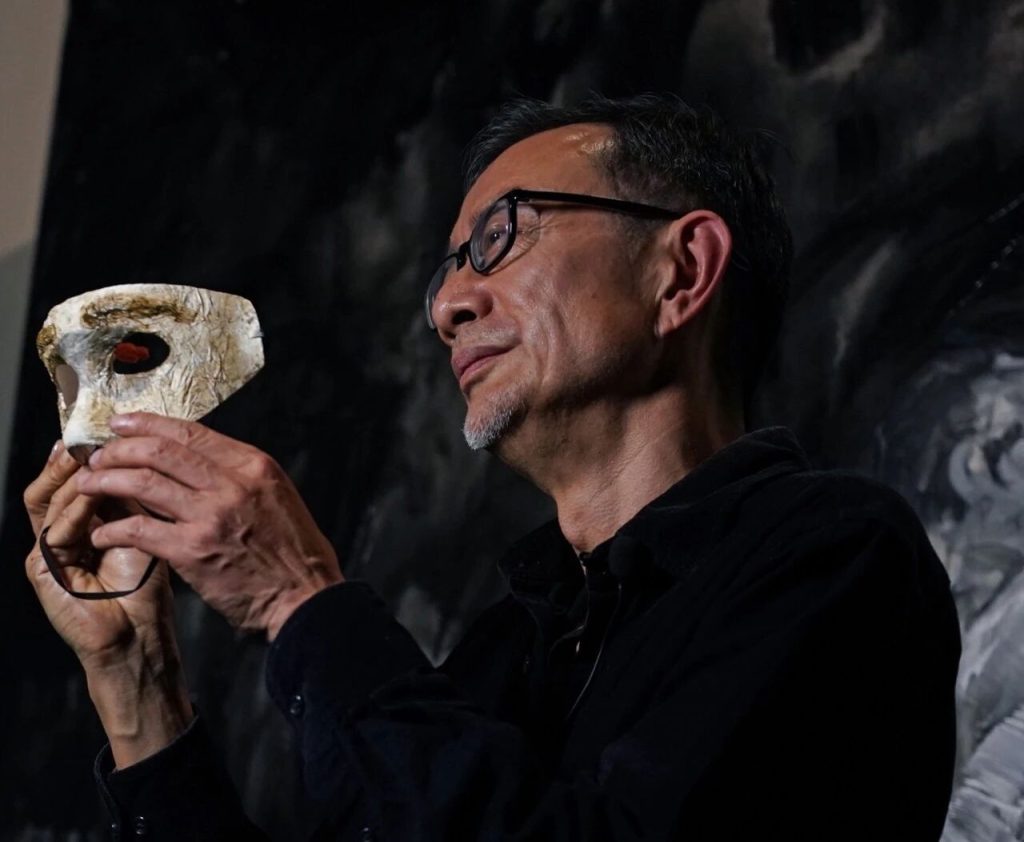
Zhao Chuan, born in Shanghai in the 1960s, creates works spanning theater, literature, film, and contemporary art. He is a co-founder of the independent theater troupe “Caotai Ban,” whose collective theater productions include Factory of the World (2014) and History of Youth (2023). He is dedicated to exploring how art and social practice intertwine—examining the roles of the individual, the collective, the body, critical thinking, documentation, and poetry within this interplay. His publications include A Brief History of Radical Art (2015) and The Theater That Never Gives Up (2021).
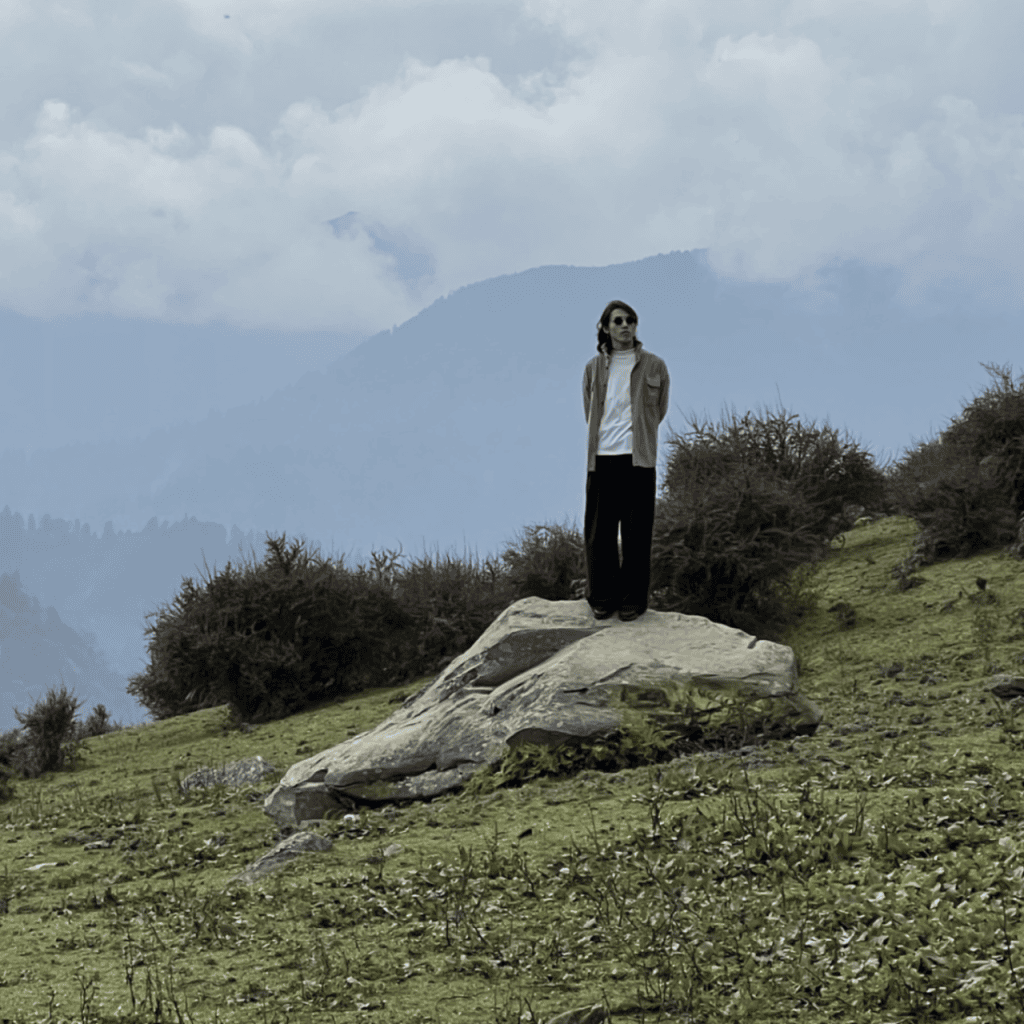
Shao Ye is an artist. His current social identity is that of an internet industry professional dedicated to artistic creation; he lives and works in Shanghai. In recent years, he has been exploring the boundaries of the “live” experience: traversing mountains and rivers, or walking through human society, using his body as a medium to continually deepen his “pseudo-theatrical” artistic practice. Some of his works are designed to span his entire life journey; he deeply cherishes the philosophy that “the artist himself is his greatest work.” He has been deeply involved in art projects such as the UP-ON International Live Art Festival, the In the Clouds International Live Art Festival, and Rebe Live Action, and his works have toured multiple countries and regions, including Southeast Asia, Argentina, and Moscow.

Project Title Sponsorship

Chengdu Shangcheng Design has been deeply engaged in architecture and spatial design for over two decades, consistently focusing on the relationships between architecture, nature, culture, and society. The firm has developed an integrated design practice encompassing urban planning, architecture, landscape architecture, and interior design. Its projects are located in numerous cities across China and span a wide range of types, including industrial parks, office buildings, cultural exhibition spaces, and residential spaces. With a focus on spatial value and user experience, Shangcheng Design is committed to providing clients with architectural and spatial solutions that combine foresight, aesthetic appeal, and practicality. The firm’s work has been recognized with numerous domestic and international awards, including the China Interior Design Awards and IFI International Interior Design Competition, the Architecture MasterPrize (AMP), the BLT Built Design Awards, the DNA Paris Design Awards, the Milan Design Awards, the London Design Awards, and the Architect of the Year Awards.