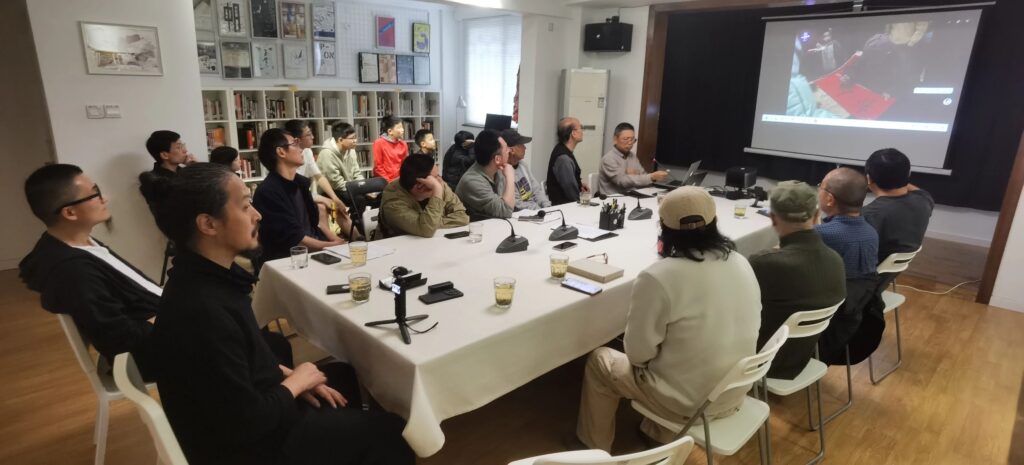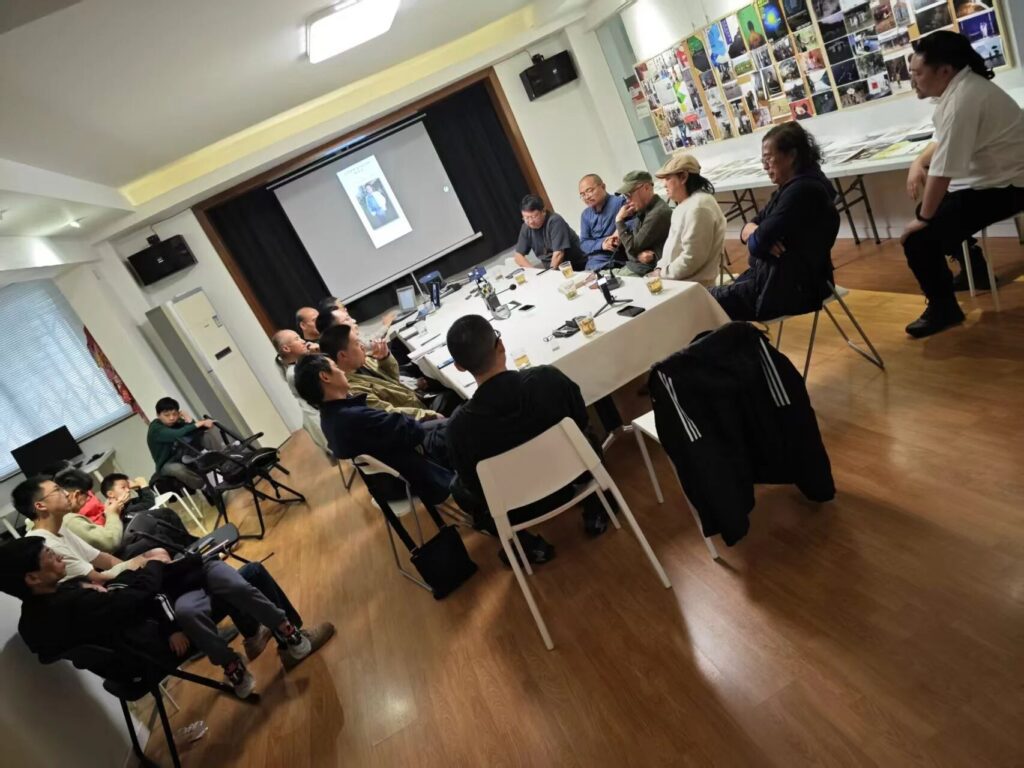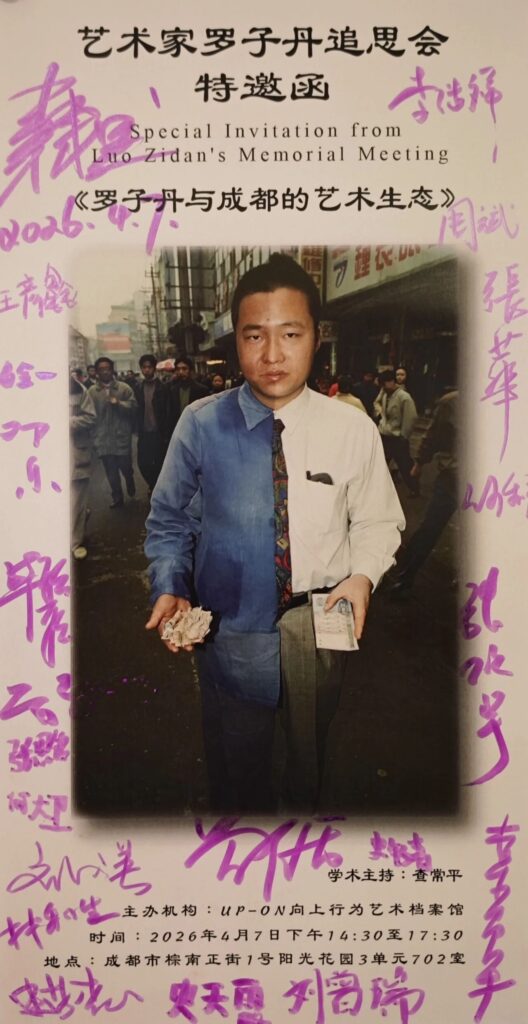
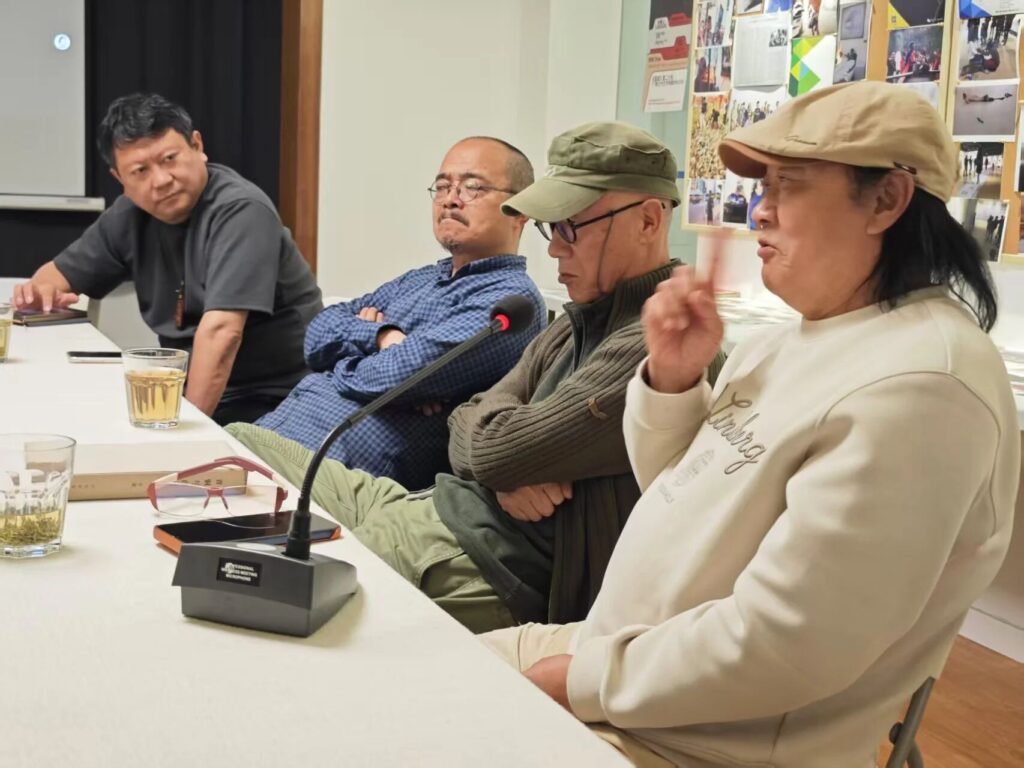
On the afternoon of April 7, 2026, we gathered at the UP-ON Performance Art Archive to hold a simple memorial service for the artist Luo Zidan (1971–2025). There was no grand ceremony, nor any emotional manipulation; most of those in attendance were old friends and acquaintances who had interacted with him, chatted with him, and shared their lives with him over the past three decades.
In quiet reflection, we revisited some of Luo Zidan’s performance art works. As the images flashed by frame by frame, many memories came flooding back. We reminisced about the times we created art together, recalling his straightforward and uncompromising nature, as well as his wildly imaginative yet incisive ideas. Our words were tinged with emotion, and our silences were filled with fond remembrance.
Luo Zidan’s sustained artistic practice in the latter half of the 1990s—direct, sincere, and bold in both thought and action—played a significant role in fostering Chengdu’s free artistic ecosystem. This gathering felt like a reunion of old friends, where everyone bid farewell to Luo Zidan in the simplest, most heartfelt way. May he remain free and passionate in heaven, continuing to do what he loves.
List of Attendees at the Memorial Service (in pinyin order):
Bi Congcong, Chen Mo, Deng Le, He Liping, He Dawei, Huang Xiaorong, Li Jixiang, Liu Chengying, Liu Zengrui, Lin Hesheng, Luo Yanzhi, Ma Zhi, Ma Heyi, Wang Lin, Shao Ning, Shi Suyao, Shi Muqing, Shi Tianlu, Wang Yanxin, Yu Ji, Zeng Xun, Zeng Qunkai, Zhang Hua, Zhang Xinyu, Zhang Yingchuan, Zhang Enming, Zhou Bin, Zhu Cheng.
Host: Cha Changping
In the order of their remarks, we have excerpted the following passages to express our remembrance of the artist Luo Zidan on the occasion of his passing!
Session 1 | 2:00–3:30 p.m
Searching for Our Roots Together
Zhang Xinyu: I first met Zidan through an interview, and we eventually became close friends. He would sometimes invite me to collaborate on his works, which led to our trip to his hometown of Changning, Yibin, during the 2001 Spring Festival to film a documentary about his series of works. Although this film, spanning 25 years, remains unfinished to this day, the more than ten works Zidan led the villagers to create and perform collectively back then—engaging the entire clan—still leave a profound impression even today. Zidan’s performance art was never a solitary act; he excelled at delving into the fundamental layers of society, transforming spectators into participants. He wove the exchanges, interactions, and actions between the artist and people of diverse backgrounds into integral components of his work, sparking reflection on the clash of ideas within modern society. Though Zidan left us far too soon, his work remains worthy of study by the art world and society for many years to come.
Reflections on Luo Zidan
Wang Lin: Reflecting on Luo Zidan and discussing his contributions to performance art is a particularly worthwhile endeavor—because today, constrained by institutional frameworks, capital, education, utilitarianism, and the state of humanistic literacy, spontaneous and autonomous performance art emerging from the grassroots represents the true contemporary art that possesses a critical consciousness and a pursuit of freedom. It can fight its own battles, seizing every opportunity, and use the gaps between individuals and public spaces to create extraordinary, outstanding works of art for this most uncertain of eras.
The achievements of performance art in Chengdu—which, across three distinct phases, have continuously shattered the illusion of a “land of milk and honey” and the dream of docility—deserve to be documented through the method of archival realism, serving as a testament to history.
Leading Figures in Performance Art
Zhang Yingchuan: Since organizing “The Water Protectors” on the banks of the Funan River in August 1995, Chengdu’s performance art scene has enjoyed over 30 years of steady and sustained development. The exhibitions, exchange platforms, and archives established by the community have earned it a reputation both domestically and internationally for its proactive and dedicated efforts. I believe one key reason for this is that the Chengdu performance art collective embraced a public-oriented approach from the very beginning of their artistic practice. As a prominent representative of this artist community, Luo Zidan carried out more than 30 performance art projects in Chengdu between 1996 and 1999.
The performance “Half White-Collar, Half Peasant,” staged on the morning of December 4, 1996, on Chunxi Road, caused a sensation and became a household name in Chengdu at the time. Even now, looking back at the photographs taken at the scene, one can still sense the sharpness of the work.
Removal of the Work
Chen Mo: In the late 1990s, director Wen Puling, drawing on the rich historical materials of domestic performance art from the 1990s, devoted immense effort to compiling the book *Chinese Action: Dedicated to the 21st Century—Performance Art from the 1980s to the 1990s*, accompanied by a 50-minute DVD featuring representative works by numerous influential local artists both at home and abroad. The publication circulated widely within academic circles. Suddenly one day, Luo Zidan approached Wen Puling, angrily accusing him of including his representative work *Half White-Collar, Half Peasant* without his permission, claiming this constituted a serious infringement of his copyright and intellectual property rights. He demanded that Wen immediately recall all distributed copies of the art book and CD and destroy them. This unexpected turn of events left Old Wen in agony and completely flustered. He therefore endured the substantial financial loss, removed Luo Zidan’s work, and reprinted the book and CD.
Engaging with Social Issues Through Identity
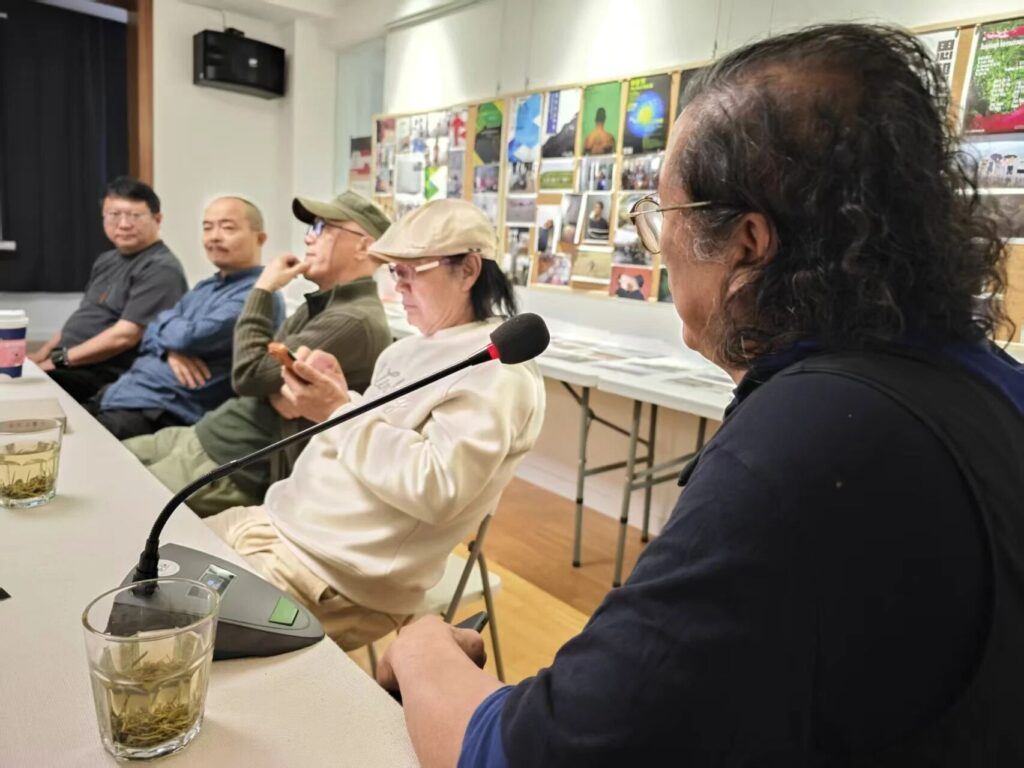
Deng Le: Luo Zidan streaked across the sky of Chengdu’s contemporary art scene like a shooting star—a truly tragic loss. The fact that everyone put aside their work to gather here, bringing images and memories to pay tribute together, speaks to the warmth and vitality of Chengdu’s art community.
I knew him for many years; we often spoke late into the night and exchanged ideas while participating in exhibitions together. He also took part in the “Singularity·Monthly Gathering” series I curated on multiple occasions. His art engages with social issues through the lens of identity, setting it apart from performance art that focuses on the body. The relaxed environment of the late 1990s and early 2000s, combined with Chengdu’s fertile artistic soil, fostered his prolific and profound body of work.
A Passionate Artist
Zhang Hua: Luo Zidan has a somewhat obsessive personality; he is filled with passion and idealism for art. He is sincere and open-hearted, with a unique creative approach that leans toward the emotional and spontaneous. He possesses strong execution skills and is unafraid to express himself, effectively integrating his life experiences and personal journey into his artistic creations. His works focus on issues such as urban consumerism, environmental pollution, identity fragmentation, spiritual alienation, and familial memory, reflecting the social realities and spiritual characteristics of the era in which he lives, and are worthy of remembrance.
Binary Intervention
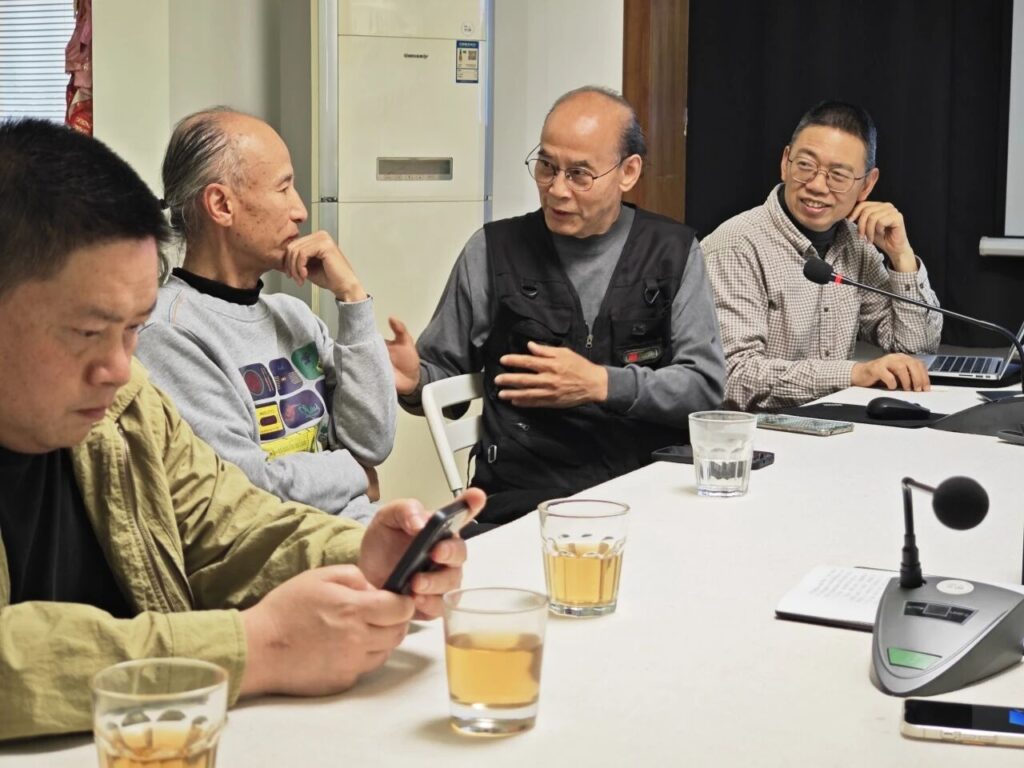
Zeng Qunkai: Compared to conceptual, elite, or trend-driven artistic styles, Luo Zidan primarily draws upon the collective experiences of the 1990s, modern performance art, and primal language. Through intuitive methods such as juxtaposition, conflict, duality, intervention, and interdisciplinary approaches, he clearly “materializes” the individual’s predicament amidst an era of transformation, revealing the “flow rates” of urban-rural “buffer zones,” clan kinship, traditional society versus globalization, and the pre-modern body in relation to contemporary civilization. Resonating with the spirit of the times, his exploration of collective disunity and the “spiritual” connections of identity and belonging signifies the continuous optimization of the local ecosystem.
Session 2 | 4:10–5:40 PM
The Paradox of Sincerity
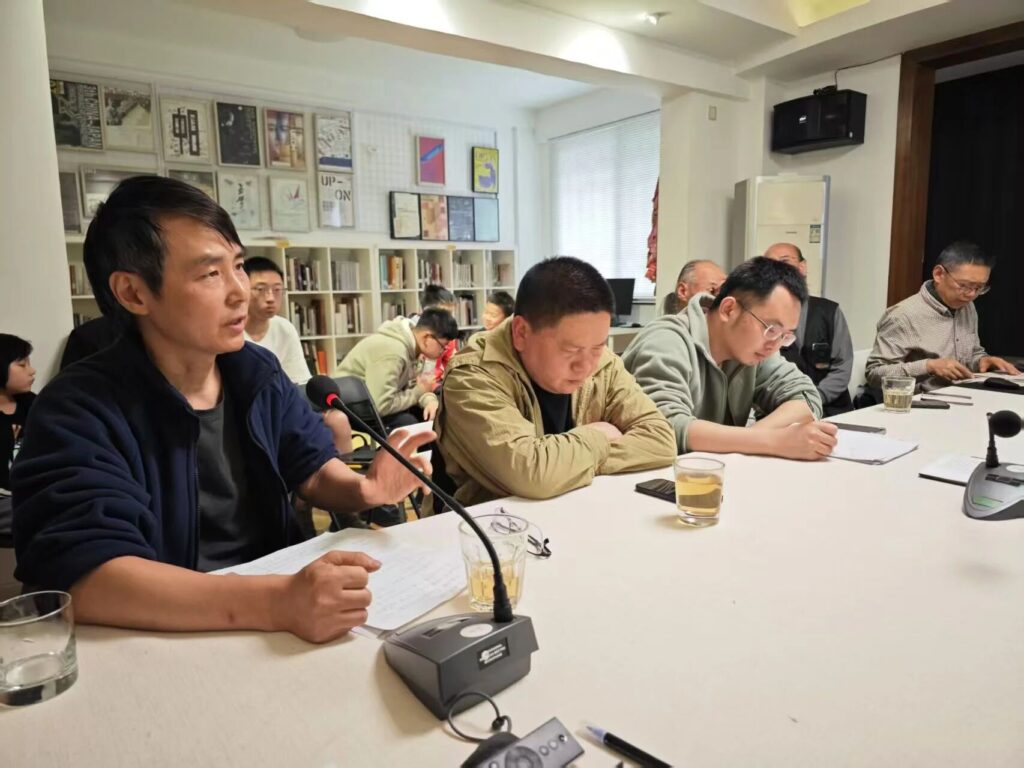
Lin Hesheng: Brother Luo Zidan said that sincerity leads to depth, and depth leads to paradox. But sincerity is a double-edged sword. Having eaten the fruit of wisdom, human sincerity is unable to self-reflect and correct “the hidden faults I am unaware of” (Psalm 19:12), and so the world is filled with hurt and suffering. Unless we redefine life and creation from “God’s perspective”: “ When I consider Your heavens, the work of Your fingers, the moon and the stars, which You have ordained, what is man that You are mindful of him, and the son of man that You visit him?” (Psalm 8:3-4)
A Thorn
Li Jixiang: He is, in himself, an affront to this mundane world. Whether through his work or his character, he is a presence that cannot be ignored.
In today’s art world, where profit drives everything and art is peddled with sleaziness and expediency, it is he who has taught us about love and freedom, about reverence and humility.
His untamed soul is the best response to this unbearable reality. Thank you, Zidan.
Bathing in a Trash Can
Liu Chengying: In 1997, the third “Defenders of Water” art event was to be held in Dujiangyan. CCTV director Wen Puling planned to film the entire process for broadcast on the “Artistic Sky” program, and the participating artists’ proposals needed to be reviewed. Luo Zidan’s proposal was to bathe inside two trash cans. Puling thought there was a problem with it and suggested a modification. He refused to change it, stating directly, “I’m not participating in this event. I’m withdrawing.” He then walked away.This is the Luo Zidan I know.
The Lone Wanderer
Zeng Xun: Among the artists I know, Luo Zidan is a true maverick. His approach to interacting with others is unique, and his method of creating art is unique. His work gives off a very spontaneous vibe: inspiration strikes suddenly, expression is highly improvisational, and it appears somewhat rough and unpolished, with blurred boundaries. But upon closer inspection, one realizes that this is, in fact, his signature style.
The Scene of Conflict
Wang Yanxin: I came to Chengdu after graduating in 2013. I’ve only met Professor Luo Zidan twice, but what left a deep impression on me was that every time we met, he would talk to me very earnestly about his work. When viewed from a methodological perspective, Luo Zidan’s work exhibits many structural differences from that of his contemporaries in performance art. His true breakthrough lies not in the “performance itself,” but in his unique structural language of performance—particularly his ability to organically interconnect imagery, space, and narrative. Performance is no longer merely a physical act; it has become “the scene of conflict between reality and imagery.”
Life and Fate in Art History
Bi Congcong: Luo Zidan was an artist of unique character and temperament. His heart was sincere, yet he was burdened by his own nature; these two elements together shaped his brilliant yet tragic life. He struggled to find his place in society, yet valued the collective over the individual; he staked his life on artistic ideals and critical truth, and on a spiritual level, he was indeed a pioneer of his time. The departed need not continue to bear the heavy burden of history; that burden, once borne by him, is now borne by history itself. Luo Zidan must indeed be remembered by history; his life and art are now part of art history.
Making Artists’ Work Visible
Zhou Bin: Attending Luo Zidan’s memorial service, I recalled the moments we shared; his forthright and earnest demeanor seems to be right before my eyes, filling my heart with sighs and deep emotion. Luo Zidan’s sudden passing at the age of 55 has made us acutely aware of the urgency of collecting and organizing archival materials in the field of performance art—a task that truly cannot wait. When we founded the UP-ON Performance Art Archive, our original intention was to dedicate ourselves to the collection, organization, and research of performance art documentation, and to foster a healthier ecosystem for the art form. This was because, ever since its emergence in China, performance art has remained at the center of controversy, long marginalized and demonized. We sincerely hope that more like-minded individuals will join hands to build the UP-ON Archive into a robust institution, preserving performance art so that artists’ work may be cherished, seen, and studied.
The Gadfly of the Age
Liu Zengrui: Teacher Luo Zidan has been battered by the times, just like the clay figure in his work *Inheritance*, which was passed from hand to hand until it finally turned into a lump of mud. *Half White-Collar, Half Peasant* reminds me of Wang Shuo, who self-deprecatingly called himself a “bastard” and a “deviant of the literati,” and was viewed by others as a “thug” and a “hoodlum.” I, however, feel that “thug” (luomang) is a homophone for “horsefly” (niufeng)—precisely the “thorn” Professor Li Jixiang spoke of. May the Lord welcome him into Abraham’s embrace.
A Tonic Against Mediocrity
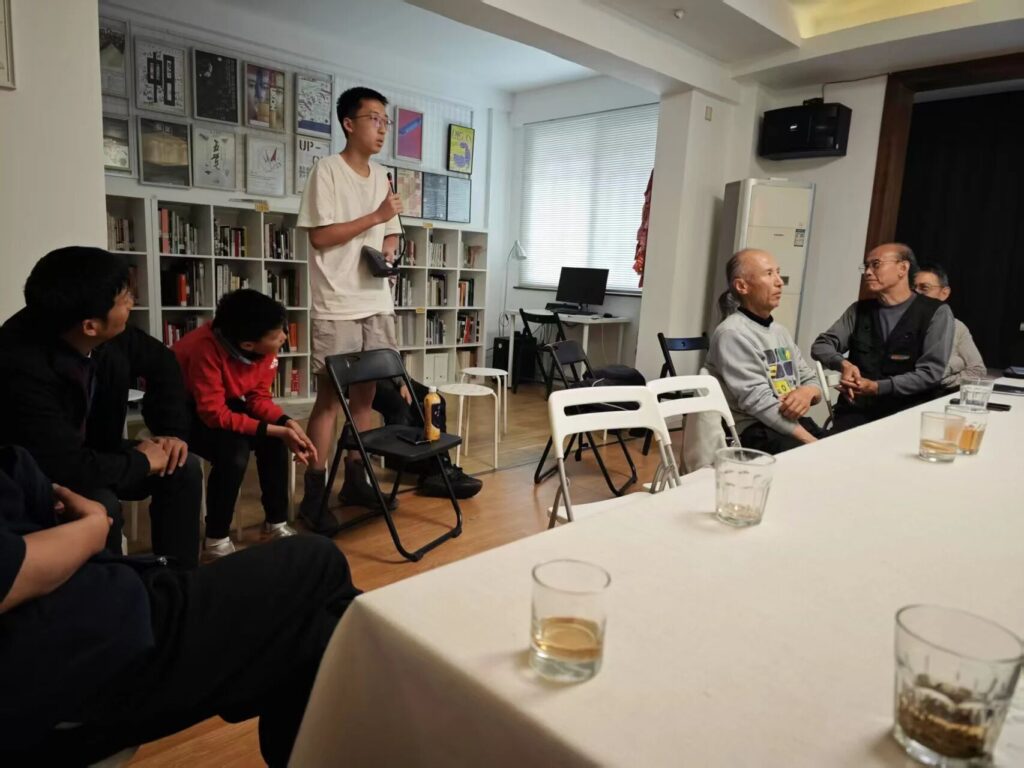
Zha Changping: At the memorial service on Tuesday afternoon, I saw in the footage the Qu Yuan-like expression of anguish and inner conflict that Brother Luo Zidan often displayed in the 1990s, and I couldn’t help but recall fragments of my interactions with him between 1995 and 1997.
At that time, he frequently carried out his performance art with single-minded determination along the riverbanks of Chengdu, in front of bars, at university gates, and on the streets of Chunxi Road. His works often centered on themes of identity, ecology, and the public nature of art, emphasizing the interactive emergence of art within the relational world. Although they garnered frequent coverage in newspapers and on television, none of this brought rest to his restless soul. At times, he would sit alone in a corner, chain-smoking, as if finding temporary solace in the swirling clouds of smoke. Since we always treated him as a normal person in our interactions, his words and actions sometimes caused us genuine pain and awkwardness! In truth, isn’t this a wake-up call for our own mundane lives? Isn’t this the true value that Van Gogh-esque works bring us?
Session 3 | Echoes from Afar
Luo Zidan’s Phone Calls
Huang Xiaorong: For nearly a decade now, as if by some unspoken agreement, Zidan has called me once a month. The calls range from ten minutes to half an hour or longer; during each conversation, I am a listener who occasionally interjects. On the phone, he often spoke of He Duoling and Zhou Chunya, rarely mentioning other painters; when it came to painting, he discussed only oil paintings, as well as “White Night” and various events in Chengdu’s poetry circles, including his own interpretations of the long poems he had written. He would quote passages from the *Tao Te Ching* and the *Bible*, possessing a kind of martyr-like obsession, though I never gave much thought to the specific connection between his “obsession” and those two texts.
Freedom of the Heart
Yu Ji: Regarding Luo Zidan, his life and his performance art offer many angles for discussion. There were also quite a few amusing and interesting stories from his past, though of course none of that matters now. Luo Zidan remained true to his own understanding of performance art; he thought deeply, treated action as thought, dared to express himself, and had the courage to present himself, steadfastly holding to his convictions from beginning to end. He strove to be true to himself; his heart was free. This in itself is a form of liberation, a success, and a source of satisfaction. He was a force to be reckoned with during his active years in Chengdu, yet now he has departed quietly—a cause for deep sighing and lamentation. Alas, may God bless him. And may He also bless those steadfast souls still struggling through the hardships of this world. Amen!
The Temperament of Contradiction
Zhu Cheng: You possess an innate temperament of contradiction. This is precisely what makes Luo Zidan who he is. You also have a spirit of inconsistency between your outward appearance and inner self. Your bewildering demeanor is something that requires no deliberation. It is intuition. I feel fortunate to have met you and exchanged thoughts with you; I have never written such words to anyone else in this lifetime. (April 18, 2008, 8:18 PM)
Luo Zidan: I’m flattered! But I must say, you’re quite skilled at shifting the focus (laughs). Everyone has multiple facets; creative people all possess a contradictory (paradoxical) temperament. You, Zhu Cheng, surpass even Zidan in this regard. It’s also intuition—I feel fortunate to have met you and exchanged thoughts… Writing words like these is truly a first. (April 18, 2008, 8:43 PM, excerpted from the two’s WeChat chat)