The “Research Room” section of the UP-ON Archive aims to revitalize archival materials through theoretical research, seminars, self-publishing, and other means, thereby fostering in-depth knowledge production.
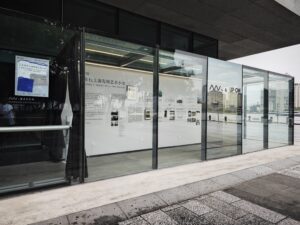
On June 17, 2026, the first project of the MAM & UP-ON Live Art Documentation Center, *Rustic Art: Uncovering the Past*, was launched in Shanghai. The theme of the inaugural documentation exchange event was inspired by Zhao Chuan’s book *A Brief History of Radical Art: Chronicles of 1980s Shanghai*. We interviewed Zhao Chuan about the origins and subsequent developments of the book. This article is an excerpt, reviewed and approved by the interviewee.
Interviewee: Zhao Chuan
Interviewer: Shao Ye
Date: March 31, 2026
Location: Zhao Chuan’s Studio, Shanghai
Shao Ye: Hello, Professor Zhao Chuan. We are currently organizing a documentary exchange event centered on your book *A Brief History of Radical Art: Chronicles of 1980s Shanghai*, and we’d like to ask you about your initial motivation for writing it.
Zhao Chuan: It’s been quite a while. I left Shanghai in the late 1980s and lived elsewhere for a considerable time. When I returned to Shanghai in the early 2000s, there were many things I didn’t understand. I mean, how did society—and the relationship between people and society—in the 1980s transform into the highly materialistic environment we saw after 2000?
Later, I gradually began to explore the so-called social transformation and asked around among people I knew, but in general terms, it was hard to explain clearly. It was actually related to Deng Xiaoping’s Southern Tour—around 1992 or 1993—when the social atmosphere changed completely, and people were making business calls everywhere. I was particularly curious about this process and wanted to understand exactly what had happened.
At that time, I hadn’t yet begun my later work in theater; I was mainly writing essays and novels. As a writer, I naturally wanted to use the medium of text to reflect on and explore how this transformation had come about—that was the first reason. The second reason was that people had already begun looking back on the 1980s, which was an artistic movement I had experienced during my own adolescence. When I saw Lü Peng writing the history of contemporary art in the 1990s—even though the 1990s hadn’t yet ended—I felt it was at least imprudent to be writing about it so soon. Take Shanghai, for example: writers might just show up for a week or so, visit a few studios, and then start theorizing. And everything seemed to revolve around some pre-set central theme or theoretical vantage point. Based on my own experiences with the ’80s and ’90s, as well as the ’85 New Wave, I didn’t think that was the case. I felt that kind of writing was too crude and driven by an excessive desire for power. Since I was also engaged in art writing and criticism at the time, I decided to write something myself.
In the early 2000s, several opportunities arose. One was curating a special issue for *Art World* magazine on Shanghai’s avant-garde art of the 1980s; another was an invitation from the magazine to write about the development of abstract art in Shanghai. From the late 1970s through the early 1980s, we gradually began to see abstract paintings in Shanghai artists’ studios and even at exhibitions, such as the “Exhibition of Ten Artists” in 1983. The “Abstraction” series was serialized in *Art World* for a time, with one installment published each month, each running several thousand characters. While working on this series, I conducted many interviews like the one we’re having today—talking with artists, reading materials, and researching the broader context. After writing for over a year, I had accumulated a substantial body of work. Then a friend approached me with a proposal to turn my research on the development of abstract painting in Shanghai into a book.
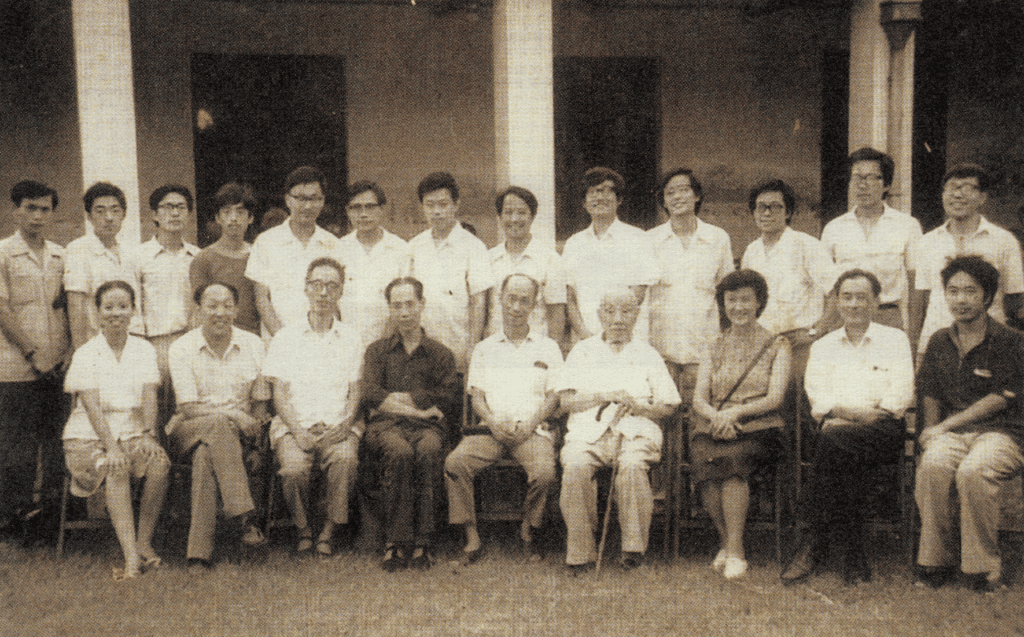
“The ‘83 Phase Experimental Painting Exhibition” (Group Exhibition of Ten Artists), September 1983, Group Photo at the Opening (Front row, from right): Li Shan, Meng Guang, Huang Zongying, Yan Wenliang, Yu Heng, Lin Ximing, Liu Zengfu, Ada, Zhang Yachun; (Back row, from right): Wang Bangxiong, Zhang Jianjun, Fang Fang, Leng Hong, Gao Jin, Cha Guojun, Xu Keran, and students from the Fudan University Student Union
After *Shanghai Abstract Stories* came out, I felt a bit of regret—I wasn’t actually all that interested in those discussions about abstract painting. It seemed that artists later became more concerned with the path to success, with developing their own so-called “signature” visual language, and with brand marketing. What truly interested me was a certain intensity that existed during that naive era of the 1980s. What was that intensity? And how did it fade away and shift direction by the 1990s? I was curious about this, so I turned my attention to writing *A Brief History of Radical Art*. It wasn’t originally titled that—the earliest title was *Borrowed Art*. I felt that at the time, many artists were drawn to Western art history; they studied it, often misinterpreting it, and exploited information asymmetries in their creative practice to address their own spiritual dilemmas. This was very close to what Lu Xun described as the “borrowing” philosophy.
From the late 1970s through the 1990s, I situated the discussion of radical art within the context of China’s social transformation—it wasn’t just about changes in visual language or the pursuit of artistic concepts; it went far beyond that. The book addresses people, the socio-political and economic environment, and touches on many real-world issues. It encompasses the so-called political campaigns we experienced, as well as changes in state policies, social ideals, and much more.
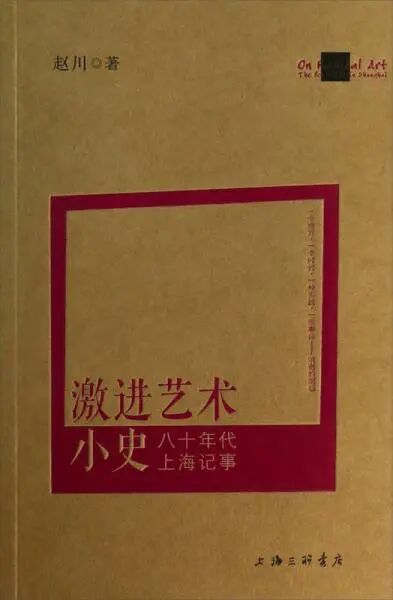
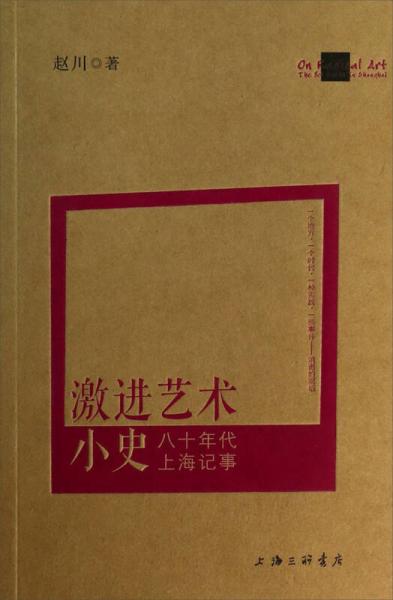
*A Brief History of Radical Art: Chronicles of 1980s Shanghai* by Zhao Chuan, published by Shanghai Sanlian Bookstore in 2014
Shao Ye: It’s basically impossible to publish this book right now.
Zhao Chuan: That’s right. After finishing *A Brief History of Radical Art*, I felt I’d done my part—I’d fully documented what I’d seen and understood about that period. The earliest draft actually couldn’t be published at the time either. If it couldn’t be published, so be it; I just tucked it away in a drawer, and that was that. Later, when Wu Liang was editing the magazine *Shanghai Culture*, he had always been quite interested in my writing. He wanted to publish a special issue and asked if I had any longer articles. I told him I had this manuscript, but didn’t think he’d be able to publish it. He suggested I select a portion of it. I chose passages from the 1990s that touched less on social events. After it was published, the response was actually quite good. At the time, Mr. Yan Bofei, the owner of Jifeng Book Garden, was also publishing academic books through Sanhui Books. He asked me, “Does this manuscript have a publisher?” I said no. He replied, “I’ll publish it for you; I have special connections.” I agreed. The process was quite eventful, and by the time it was finally published, several years had passed. The necessary cuts and revisions were still made, so the final version you see is a clean edition. It was published over a decade ago, and I suspect it wouldn’t be possible to publish something like this today.
Shao Ye: Yes, much of the content in the book would be hard to imagine being published by a state-run press today. You mentioned earlier that the book was finalized sometime between 2004 and 2008?
Zhao Chuan: Right. As I recall, I wrote it between 2004 and 2008. I think it was published in 2015.
Shao Ye: Do you still have the original manuscripts from back then? I mean the unedited original manuscripts.
Zhao Chuan: Maybe? I don’t remember clearly, since I’ve gone through so many different computers.
Shao Ye: Let’s focus on this book specifically. The title is *A Brief History of Radical Art*. How do you define the term “radical art”? How does it differ from commonly used terms like “avant-garde” or “modernist”?
Zhao Chuan: In the 1980s, people talked about “New Wave Art”; in the 1990s, it was “Avant-Garde Art,” or terms like “Modernism” and “Modernist.” When I was looking for a theoretical framework, I felt that none of these terms were quite suitable. That’s because most of these terms were borrowed from Western art history, where they have their own clear definitions—which time period, which geographical scope, what sparked them, and how far their scope extends. A great deal of discourse already exists there—some of it may be ambiguous or overlapping, but it’s essentially clear. When these concepts are applied to China, especially in the context of exchange, they can easily lead to confusion. For example, “avant-garde art” was, in fact, already a term used in the West during the 1990s to describe a period that had come before. What’s important is: what is the spiritual essence of this art within our own context? The choice of terminology is meant to capture that essence. “Radical” might be a more fitting term. This term itself isn’t a concept that emerged directly from an art movement, but rather from social movements—such as the French Revolution. Therefore, whenever we speak of radicalism, it is always linked to social, ideological, and activist dimensions. I recall that at the launch event for Wu Liang’s special issue, when Yan Bofei read that section, he remarked that it represented the intellectual history of a very small segment of this city’s population—yet this intellectual history is of great significance to the era and to the city’s culture, as it contains a core essence.”
Shao Ye: So the term itself carries a certain ideological bias.
Zhao Chuan: *A Brief History of Radical Art* covers the period up to the mid-to-late 1990s and doesn’t go any further; I feel that marks the end of a chapter. This relates to my understanding of how that spiritual journey unfolded. The market arrived, along with many other changes, and artists began to navigate their new lives with fresh approaches and a renewed spirit. Therefore, the term “radical” is more suited to the national conditions—or rather, the political and cultural environment—of the 1980s.
Shao Ye: This kind of unique perspective is quite rare in our art history today. Most people are accustomed to using imported terms like “avant-garde,” “contemporary,” or “modern.” Another term in the book’s title is “A Brief History”—from what historical perspective do you position it?
Zhao Chuan: It is certainly not art history; it doesn’t qualify as such, because it is merely a fragment. The “spiritual history” aspect I mentioned earlier also pertains only to a very small, highly marginal group of people. We’re only discussing a very limited segment—a very brief chapter.
Shao Ye: Just a small part of that era that aligns with your perspective on radical art. So from your perspective, it’s just a tiny fragment within the broader context of art history.
Zhao Chuan: Whether it’s “big” or “small” isn’t the core issue; there’s no need to exaggerate its significance.
Shao Ye: What significance do you think your approach—this relatively personal, unofficial way of writing a “minor history”—brings to this kind of archival exhibition, compared to more official ones?
Zhao Chuan: Actually, it’s quite good, because what you’ve been given is a corner. If you were given both exhibition halls, then the “minor history” wouldn’t work, right? It’s just right that we’re a minor history in a corner; I think it’s quite fitting.